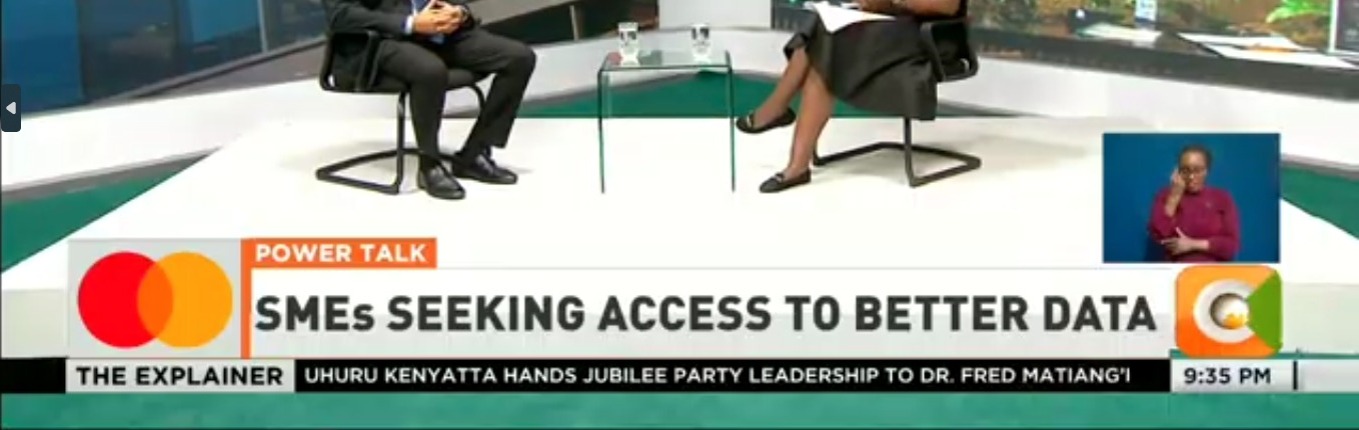
Your business is already generating valuable data every day. SeekersPark helps turn that activity into a digital business history you can understand and build on.
There is something interesting happening to small businesses.
For years, a business could survive with a shop, a phone number, a few employees, loyal customers and a good memory.
The owner knew what was selling.
The shopkeeper knew which customers came every week.
The supplier knew the business was active.
And somehow, the business kept moving.
But the world around that business is becoming increasingly digital.
Customers search before they visit.
Payments are becoming digital.
Businesses are selling through WhatsApp and social media.
Banks and financial institutions are looking for better ways to understand businesses.
And businesses themselves are becoming more interested in data, analytics and automation.
This creates a question that many business owners have not really had to think about before:
What does your business look like digitally?
Not your Facebook page.
Not your WhatsApp number.
Not your Google listing.
I mean your actual business activity.
Your sales.
Your products.
Your stock.
Your branches.
Your employees.
Your customers.
Your growth.
Your business history.
That is where something like Seekerspark becomes much more interesting.
Your business already has a story
Every business has a story.
Imagine a shop that has been operating for five years.
Every day, customers walk in.
Products are sold.
Stock comes in.
Employees serve customers.
Suppliers deliver goods.
Some products move quickly.
Others stay on the shelf.
Some months are better than others.
The business grows.
Perhaps another branch opens.
Perhaps more employees are hired.
Perhaps sales increase.
All of this is evidence that the business exists and is operating.
But what happens to most of that information?
Some of it might be in a notebook.
Some in Excel.
Some in WhatsApp conversations.
Some in an existing POS.
Some in bank or mobile-money statements.
And a lot of it may simply exist in the owner's memory.
The business has a history.
But that history may not exist as one connected digital record.
This is where businesses can start missing opportunities
Imagine telling someone:
"My business has been operating for six years."
That's useful information.
But imagine being able to show:
"Here is how my business has operated for six years."
That's different.
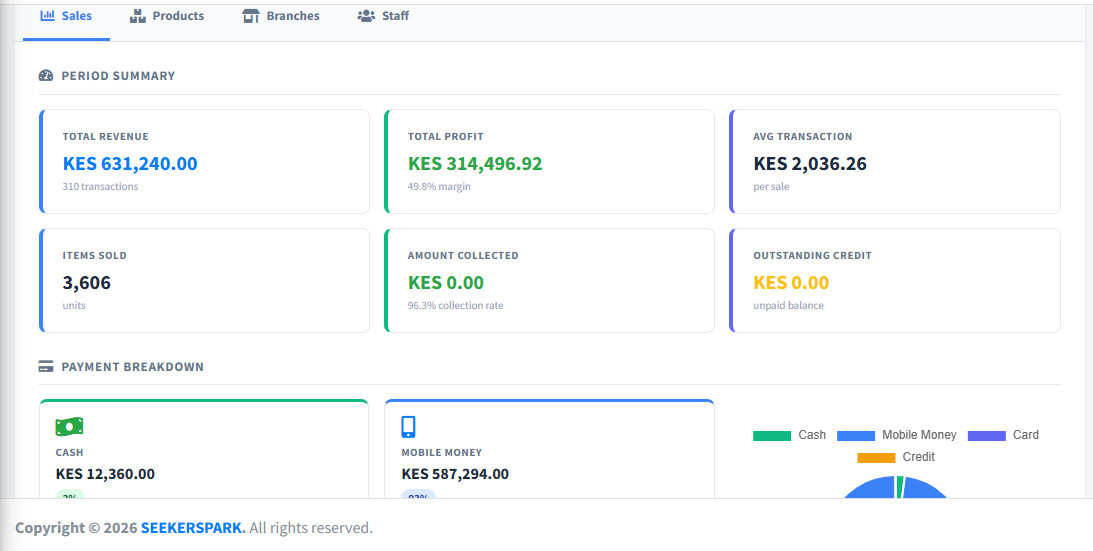
You could potentially show sales activity.
You could show product movement.
You could show business growth.
You could show branch performance.
You could show how consistently the business operates.
You could show which products actually sell.
You could show how your business has changed over time.
That is the difference between simply claiming that a business exists and having a digital history of its activity.
Why should a business care about this?
Because your business data can become useful in ways you may not have considered.
It can help you understand your own business.
It can help you identify products that are performing well.
It can show where sales are increasing or declining.
It can help you understand which branches are performing differently.
It can help you understand how your employees are contributing to the operation.
It can help you identify slow-moving stock before it becomes a bigger problem.
In other words, data isn't only something for large corporations.
Small businesses can benefit from understanding their own activity too.
And there is another side to this.
What happens when someone else needs to understand your business?
Think about a supplier.
A financial institution.
A potential business partner.
An investor.
Or even a future buyer of the business.
They may want to understand something very simple:
Is this actually an active business?
Traditionally, the answer might depend on documents, statements, conversations and whatever records the business owner can produce.
But digital business systems can create another source of evidence.
The actual activity of the business.
That does not automatically mean a business gets financing.
It does not mean every business will qualify for a loan.
And it certainly does not mean that data should be shared with anyone without the business owner's permission.
It simply means that a business can begin building a more structured record of what it does.
That distinction matters.
This is one reason we built Seekerspark differently
At first glance, Seekerspark can look like a marketplace.
You can discover businesses.
You can discover products.
Businesses can create profiles.
Products can become discoverable.
But that is only one part of the platform.
On the business side, Seekerspark provides tools for managing everyday operations.
Sales.
Inventory.
Staff.
Branches.
Receipts.
Analytics.
And more.
The idea is simple:
The system you use to run the business can also help you understand the business.
Instead of having one system for selling, another spreadsheet for stock, another notebook for staff and another place for business information, more of those activities can exist within one connected environment.
That creates something valuable over time.
Your business starts leaving a digital trail
Think about a business that starts using Seekerspark today.
Day one:
A few products are added.
A sale is made.
Stock changes.
A receipt is generated.
Day thirty:
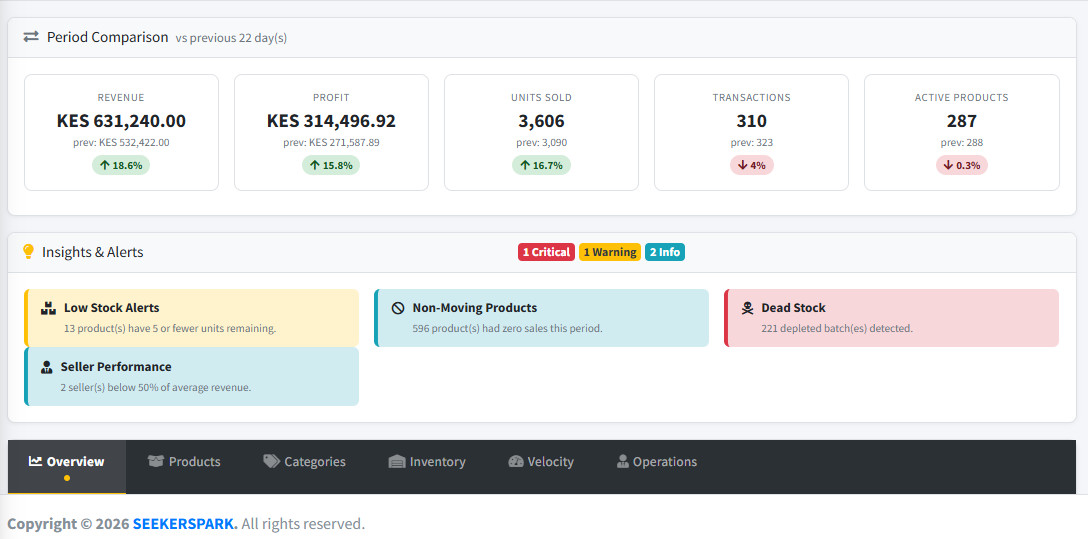
There is now a month of activity.
Which products sold?
How many transactions happened?
What was the sales pattern?
Day ninety:
There is now a three-month history.
Patterns begin becoming easier to see.
Day three hundred and sixty-five:
There is now a year of business activity.
Now the data becomes much more interesting.
The business isn't just using a POS.
It is building a digital history.
And the longer the business operates, the more useful that history can potentially become.
Your business data can tell a story
Imagine two businesses.
Both owners say:
"We are growing."
That statement is difficult to compare on its own.
But imagine that the businesses have structured operational records.
Business A might show:
- Consistent monthly sales
- Increasing transaction volume
- Strong product movement
- Growing customer activity
- Stable operations
Business B might show:
- Irregular sales
- Falling transaction volume
- Increasing unsold stock
- Declining customer activity
The point isn't that one business is automatically "good" and the other is "bad."
The point is that the data creates context.
It allows the business owner to see what is actually happening.
And potentially, with the owner's consent, it can allow other authorised parties to understand the business better too.
This is where the future of business finance becomes interesting
One of the biggest problems for smaller businesses is not necessarily that they don't generate economic activity.
They do.
The problem is that much of that activity isn't captured in a form that can easily be understood outside the business.
A shop may sell every day.
A wholesaler may move thousands of products every month.
A restaurant may serve hundreds of customers.
A hardware business may have years of supplier relationships.
But if that activity is scattered across notebooks, spreadsheets, WhatsApp messages and disconnected systems, it becomes difficult to build a complete picture.
Digital business systems can help change that.
Instead of asking a business owner only:
"Tell us about your business."
The future can increasingly ask:
"Show us what your business activity looks like."
That is a very different conversation.
Seekerspark wants businesses to be ready for that future
This is why joining a business operating platform should not only be about getting a receipt printer replacement or making checkout faster.
Those things matter.
But there is a bigger opportunity.
Every sale can become part of a history.
Every inventory movement can add context.
Every branch can contribute to understanding the business.
Every employee interaction can help explain operations.
Every month of activity can make the business history richer.
Over time, the business becomes more measurable.
And when a business becomes measurable, new possibilities start opening up.
But your data should remain yours
There is an important principle here.
Building a digital business history should not mean giving your business information away to anyone who asks for it.
Business owners should have control over when and why their information is shared.
That is why any future use of business data for things such as financing, business assessment or third-party services should involve appropriate consent and clear purpose.
The goal is not to take ownership of a business's story.
The goal is to help the business build that story in a structured way.
So why join Seekerspark now?
You don't have to wait until your business is large.
You don't need thousands of transactions.
You don't need five branches.
You don't need a huge warehouse.
You can start with the business you have today.
Because the value of business history comes from consistency.
The earlier you start recording your activity properly, the more history you can build.
A business that starts today can eventually look back and see how it has changed.
What it sold.
How it grew.
Which products became important.
Which branches performed differently.
How customer activity changed.
And potentially, with the right partnerships and consent-based services, that history could become useful beyond the business itself.
Your business is already generating data
Every day your business creates information.
A customer buys something.
An employee makes a sale.
Stock leaves the shelf.
A new shipment arrives.
A branch performs better than another.
A product stops moving.
A busy day follows a quiet one.
These aren't just transactions.
They are signals about your business.
The question is whether those signals disappear at the end of the day or become part of something you can use.
That is what Seekerspark is trying to help businesses do.
From running a business to understanding a business
This is perhaps the biggest reason to join.
Seekerspark isn't simply asking businesses to put their products online.
It is encouraging businesses to start building a digital operating history.
A history that can help the owner understand the business.
A history that can make the business more visible.
A history that can make its operations more measurable.
And potentially, as the ecosystem develops, a history that can help authorised financial and business-service partners understand the businesses they serve.
The future of small-business technology will not only be about selling more.
It will also be about being visible, measurable and understandable.
Your business is already doing the work.
It is already serving customers.
It is already moving products.
It is already generating economic activity.
The question is: are you capturing that history?
Start building it today.
Start with Seekerspark.
Log in to leave a comment.