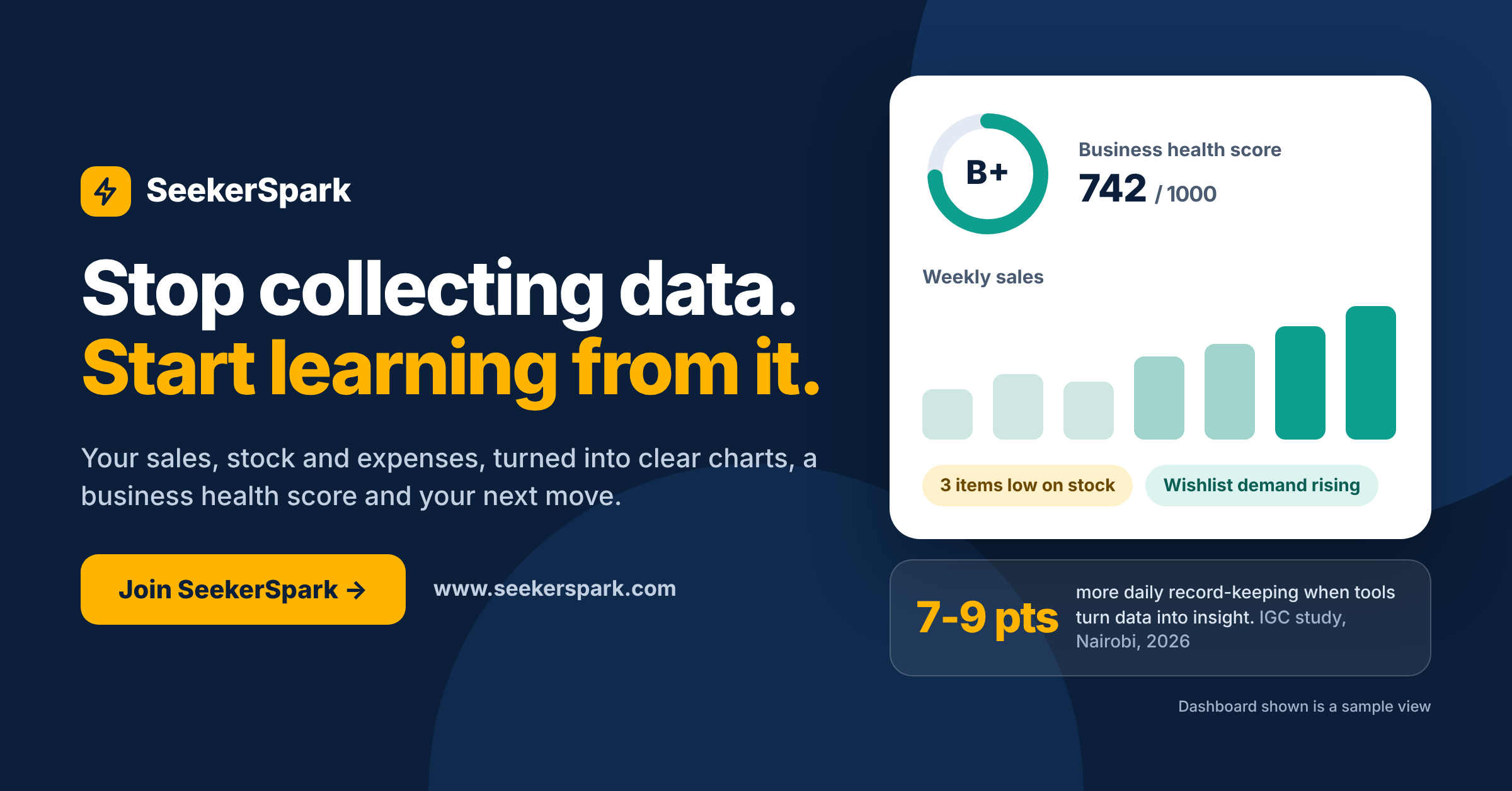
Most business owners already believe in keeping records. What holds them back is that raw records take time to turn into decisions, and SeekerSpark is built to do that part for you.
You know records matter. So why aren't you keeping them?
If you run a shop, a wholesale outlet or a service business, you have probably told yourself that you should track sales and stock more carefully. You are in good company. In a baseline survey of retail businesses in Nairobi, over 85% of owners said sales and inventory records were at least moderately useful. Yet nearly 40% kept records less than daily, or not at all.
The owners who skipped records most often named the same two reasons: no time, and the work is difficult.
A new policy brief from the International Growth Centre (IGC), by researchers Anik Ashraf and Elizabeth Lyons, argues the real problem sits one step later. Collecting numbers is the easy part. Turning a pile of numbers into a decision about what to stock, when to reorder and who to extend credit to is what takes time most owners do not have. If records never answer a question, there is little reason to keep writing them.
What the Nairobi research found
The researchers ran a randomised trial with over 2,000 retail businesses in Kenya, in partnership with Technoserve Kenya. Every business got a free smartphone point-of-sale app. Half were later upgraded to a version that also turned their data into simple charts and plain-language summaries of sales patterns, popular products and inventory trends. Nothing about how owners entered data changed. Only what the app did with the data changed.
The results were clear:
- More record-keeping. Owners with the analytics version were 7 to 9 percentage points more likely to record sales and inventory daily, a gain of 12 to 15% over the baseline.
- Biggest wins for the busiest owners. Among those who had cited time or difficulty as their main barrier, the effect was at least three times larger than for everyone else.
- A fresh start for non-recorders. For businesses that kept no records at baseline, analytics raised the chance of recording sales in the app by 20 percentage points.
- Better decisions. Compared with businesses that got no app, app users knew their inventory better, carried a more varied product range and reported higher daily sales.
The lesson for owners is simple. Records only pay off when the tool shows you what they mean.
How SeekerSpark closes the gap
SeekerSpark is built around the same idea: capture records with as little effort as possible, then turn them into answers. Here is how the barriers the research identified line up with what the platform does.
|
The barrier |
What SeekerSpark does about it |
|---|---|
|
No time to keep records |
Sales go through the point of sale as you trade. Expenses are logged in real time, for each store and for head office. Sales made offline are batched and reconciled automatically once you are back online. |
|
Records are hard to read |
Monthly expense trends, automatic category breakdowns and visual cashflow charts replace spreadsheets. Reports export to CSV or PDF in one step. |
|
Not sure what to stock |
The wishlist system shows how many shoppers are looking for a specific product or service, without exposing who they are. You can then message those interested shoppers directly. |
|
Not sure how the business is really doing |
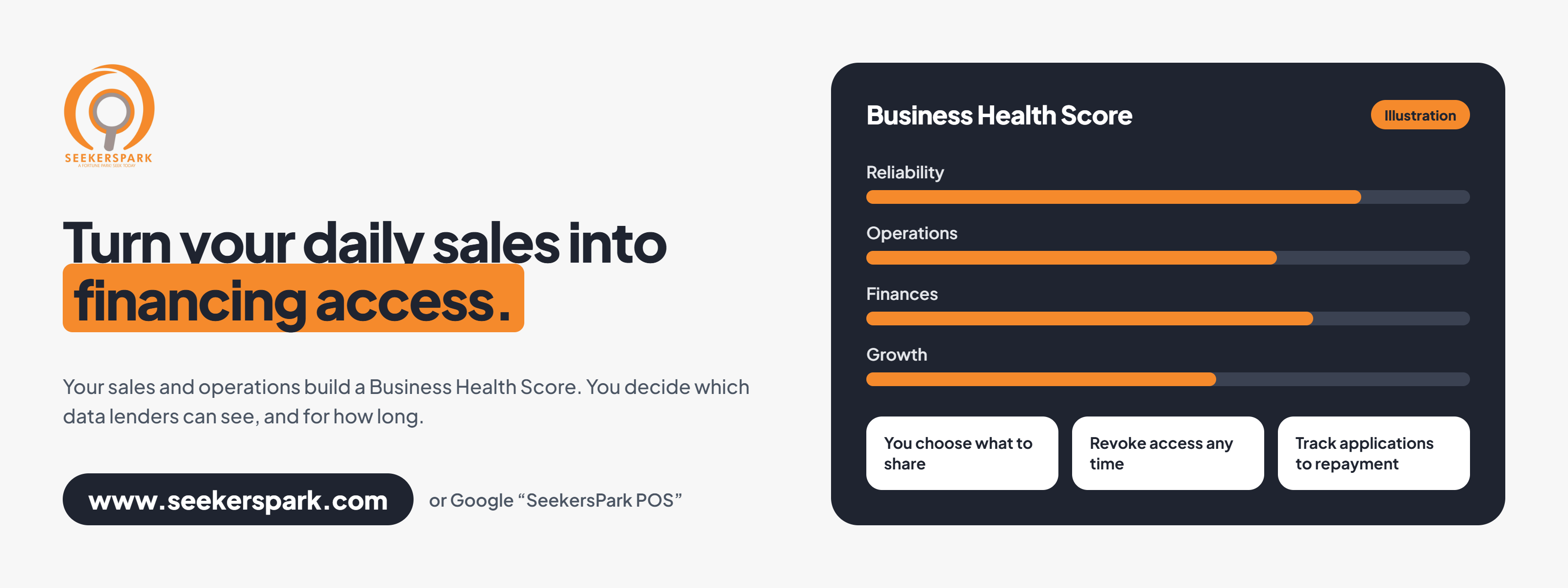
The business health score rates your business from 0 to 1000 (grades A to E) across reliability, operations, financial stability and growth. Self-diagnosis points out the bottlenecks, and you can trigger a fresh reassessment as you fix them. |
|
Money stuck with customers |
The credit ledger tracks customer accounts, repayment behaviour and overdue ageing, so you can see who owes what and for how long. |
|
Growing past one location |
The "My Empire" dashboard brings every branch and outlet under one view, with inter-branch stock transfers and approvals to balance stock across locations. |
|
Staff performance is a guess |
Set sales and performance targets for each employee and watch productivity trends, with clear roles from Director down to floor staff. |
|
Customers' opinions stay hidden |
Verified customer ratings and reviews give you honest feedback that only you, the owner, can see. |
Beyond the dashboard: records that open doors
Good records do more than help you run the shop. On SeekerSpark they become proof of how well your business is run. You decide when to share validated operating metrics with accredited lenders and microfinance partners, using scoped permissions you control. A business with steady sales, healthy cashflow and a clear repayment record has a stronger case when it asks for credit.
The platform is also built with Kenyan compliance in mind, with workflows for VAT tracking and eTIMS. Branded PDF invoices and receipts are generated and emailed to customers automatically.
Whatever your line of work, there is a fit. SeekerSpark includes dedicated tools for hotels, repair and technical service centres, property owners, and agribusiness and wholesale stockists. A labour agency portal covers verified worker catalogues and digital contracts. And a business management suite for procurement, approvals and document control is in active development, so growing enterprises will not outgrow the platform.
A note on the evidence
The IGC study tested a different app, not SeekerSpark, so its numbers describe what analytics did for the businesses in that trial. They are not a measured result for our platform. The researchers also stress that the business-performance gains they saw are short-run, since the analytics upgrade reached users only six to eight weeks before the final survey. What the study does show is why turning records into insight matters, and that is the problem SeekerSpark was designed around.
Stop collecting data. Start learning from it.
Your records should tell you what to stock, who to chase, where money is leaking and how your business is really performing. Join SeekerSpark and put them to work.
Get started: https://seekerspark.com/
Source: Anik Ashraf and Elizabeth Lyons, "Data without insight: Why small businesses under-invest in record-keeping, evidence from Kenya," International Growth Centre Policy Brief KEN-23075, May 2026.
Log in to leave a comment.